
First Flush vs Second Flush Darjeeling Tea
First Flush vs Second Flush Darjeeling Tea: What Actually Separates Them
A tea buyer once put two Darjeelings from the same tea bush in front of a customer — one pale gold, one deep amber — and asked which was the “real” Darjeeling. Both were. They just came from the same plant, on the same slope, at different points in the year. That single fact confuses more people than any other detail about Darjeeling tea: the leaf, the soil, and the garden don’t change between first and second flush. What changes is when the leaf was plucked, how the plant responded to that particular stretch of weather, and how the factory chose to process it.
That’s the whole story of first flush versus second flush. Understanding it properly means understanding three things most articles gloss over: the botany of dormancy and regrowth, the specific insect that’s responsible for Darjeeling’s most famous flavor, and the oxidation choices a factory makes once the leaf arrives.
Quick Answer
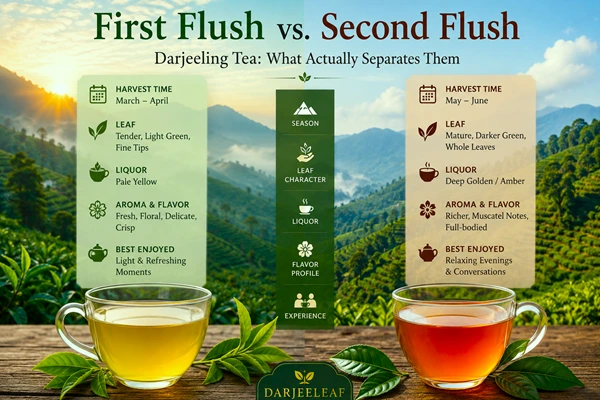
First flush Darjeeling is picked in spring (roughly mid-March to early May), lightly oxidized, and produces a pale, golden, floral, slightly astringent cup that leans closer to green or lightly oxidized oolong in character.
The second flush is picked from late May through June, oxidized more fully, and produces a darker, fuller, rounder cup known for its “muscatel”—a natural grape-like, honeyed flavor. Neither is objectively better; they’re different expressions of the same tea plant, and most tea drinkers eventually prefer one for certain occasions and the other for others.
The second flush is generally the more widely available and commercially dominant style; the first flush is scarcer, more seasonal, and often more expensive per year of harvest.
What “Flush” Actually Means
The tea bush, Camellia sinensis, goes dormant through Darjeeling’s cold winter. When temperatures rise in late winter, the plant pushes out its first new growth of the year — tender buds and the first two leaves on each shoot. That flush of new growth, and the tea made from it, is called the first flush.
Once it’s plucked, the bush grows a new set of leaves, which becomes the second flush. Later in the year, after the monsoon and into autumn, the bush produces monsoon-flush and autumn flush leaf, though these get far less attention in specialty markets than the first two.
The same framework— flush as “growth cycle,” not just “harvest event”—applies across Indian and Nepali tea regions, though Assam and Nilgiri gardens use the terminology somewhat differently because their growing seasons are longer and less sharply divided by winter dormancy.
First Flush vs Second Flush: Comparison Table
| Attribute | First Flush | Second Flush |
|---|---|---|
| Also called | Spring flush, Easter flush | Summer flush |
| Typical harvest window | Mid-March to early May | Late May through June |
| Leaf appearance (dry) | Light green and silvery-brown, downy tips | Dark brown, sometimes near-black, with golden tips |
| Liquor color | Pale gold to light amber | Deeper amber, coppery |
| Oxidation level | Light, roughly 20–30% | Fuller, roughly 60–70% |
| Signature flavor | Floral, brisk, slightly astringent, green/vegetal notes | Muscatel—grape-like, fruity, rounder, sometimes honeyed |
| Body | Lighter, more delicate | Fuller, more robust |
| Best served | Without milk, shorter steep | Without milk (traditionally), can take a slightly longer steep |
| Typical availability | Scarce: short 6–8 week window and high early demand | More widely available; largest share of total Darjeeling output |
| Relative market price | Often higher for top estate lots, driven by scarcity and early-season demand | Muscatel-grade lots from top estates can equal or exceed first flush prices; varies by garden and year |
Notes on the table: Oxidation percentages are commonly cited ranges used by tea educators and merchants rather than figures published by a single regulatory body—individual factories vary this deliberately from lot to lot, so treat the numbers as typical ranges, not fixed specifications. Pricing depends heavily on the individual garden, lot, and auction year, so “first flush costs more” is a generalization, not a rule.
First Flush Darjeeling, in Depth
What is first flush Darjeeling tea?
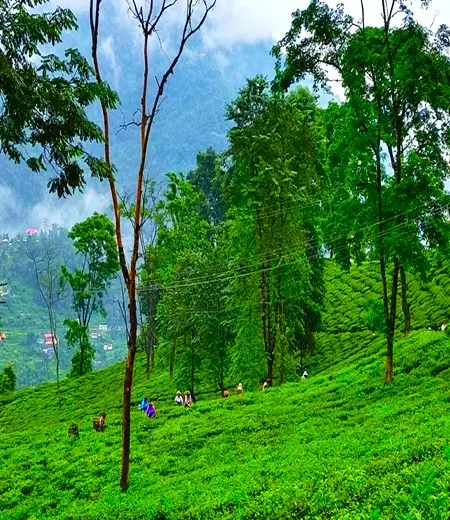
First flush Darjeeling is the tea made from the first spring growth of the tea bush after winter dormancy, plucked roughly from mid-March into early May depending on elevation and weather. It is lightly oxidized, giving it a pale golden liquor, a green-tinged dry leaf, and a flavor that’s floral, brisk, and slightly astringent rather than deeply malty.
The harvest window opens earliest at lower-elevation gardens and later at higher, cooler estates — some sources note plucking can begin as early as mid-to-late February in a handful of low-lying gardens in an unusually warm year, though the bulk of first flush production runs March into April.
Because the buds have been building up nutrients during winter dormancy, the young shoots plucked for first flush are unusually tender — often a bud with one or two very young leaves. Factories process this delicate leaf gently and stop oxidation early, sometimes producing a tea that resembles a lightly oxidized oolong more than a conventional black tea, even though it’s still classified as black tea by trade convention.
Why first flush is prized: the harvest window is short — typically four to six weeks — and the finest lots are hand-plucked, sorted, and shipped in small quantities before the second flush even begins. Scarcity, early-season demand from connoisseurs, and the labor-intensive plucking standard (often described loosely as “two leaves and a bud”) all push prices up for top-grade lots, though this varies estate by estate and year by year.
Second Flush Darjeeling, in Depth
What is second-flush Darjeeling tea?
Second flush Darjeeling is harvested from late May through June, after the leaf that was plucked for first flush has regrown. It is oxidized more fully than first flush, producing a darker, fuller-bodied cup, and it’s known for developing “muscatel”—a naturally occurring grape-like, slightly honeyed character that doesn’t appear in first flush leaf from the same bush.
The second flush is the backbone of commercial Darjeeling production. It’s more widely available through the rest of the year, and for many drinkers outside dedicated tea circles, second flush is what “Darjeeling” tastes like—rounder and more forgiving than the more delicate first flush.
The muscatel question: what actually causes that flavor
This is the part most competing articles either skip or oversimplify to “it just tastes like grapes.” The mechanism is genuinely interesting and worth explaining properly.
During the warm, humid weeks leading into the second flush, a small sap-feeding insect — the tea green leafhopper, most commonly identified in the research literature as Empoasca (sometimes referenced under the older name Jacobiasca formosana, now generally treated as part of the Empoasca complex)—feeds on the tender leaves and shoots. The bite itself causes minor physical damage: mottling, slight curling, and edge browning. In response to that feeding stress, the plant produces a range of aromatic defense compounds, commonly cited as including terpene-family molecules such as linalool and geraniol.
When leaf affected this way is withered and oxidized in the factory, those compounds develop further into the honeyed, muscat-grape character tea tasters call “muscatel.” This isn’t folklore—the leafhopper-driven mechanism has been described in peer-reviewed tea chemistry research going back decades and is now widely accepted among tea scientists and specialty tea educators, even if the exact chemical pathway is still an active area of study. It’s the same biological phenomenon behind Taiwan’s prized “Oriental Beauty” oolong, which also depends on leafhopper feeding and is sometimes described using the same “muscatel” vocabulary.
Two practical implications follow from this:
- Muscatel can’t be manufactured to order. A factory can control withering and oxidation, but it cannot force leafhopper activity. Some years and some gardens produce stronger muscatel than others—which is why experienced buyers talk about a good “muscatel year” the way wine buyers talk about a good vintage.
- The word “muscatel” on packaging is a marketing claim, not a certification. There’s no independent body verifying that a given bag genuinely has the character before it’s printed on the label, so the surest way to judge it is by tasting a dated, single-estate lot rather than trusting the word alone.
Oxidation, Explained Simply
Oxidation is the chemical process that happens when the enzymes in a broken or bruised tea leaf react with oxygen, turning green leaf progressively darker and developing the depth of flavor associated with black tea. Green tea is (broadly) unoxidized, oolong is partially oxidized, and conventional black tea is fully oxidized.
Darjeeling occupies an unusual middle ground within “black tea.” First flush is stopped early in the oxidation process — commonly cited around 20–30% — which is why it can taste closer to a green or lightly oxidized oolong. Second flush is carried further, commonly cited around 60–70%, producing the deeper color and rounder flavor associated with more conventional black tea. These are working ranges used across the trade rather than numbers set by a single regulator, and individual factories adjust them lot by lot based on the leaf and the style they’re aiming for.
How to Brew Each One
| First Flush | Second Flush | |
|---|---|---|
| Water temperature | 80–85°C (176–185°F) | 90–95°C (194–203°F) |
| Steeping time | 2–3 minutes | 3–4 minutes |
| Milk/sugar | Traditionally taken plain | Traditionally taken plain, though it tolerates milk better than first flush if preferred |
| Common mistake | Over-steeping, which brings out excess astringency | Under-brewing, which mutes the muscatel character |
Because first flush leaf is more delicate, boiling water tends to scald it and pull out excessive bitterness. Second flush leaf, being more fully oxidized and often slightly larger-leaved, handles hotter water and a longer steep without turning harsh.
Caffeine and Antioxidants: What the Evidence Actually Supports
This is an area where a lot of tea retail content overstates certainty, so it’s worth being precise about what’s well-supported and what isn’t.
Reasonably well-supported: Because first flush leaf is picked as young buds and the first two leaves, and because it’s oxidized only lightly, it tends to retain a higher concentration of catechins (a class of antioxidant polyphenols) than second flush leaf from the same bush, which loses more catechins to oxidation as it develops. This tracks with general, well-established tea chemistry: lighter oxidation preserves more of the leaf’s original catechin content, while fuller oxidation converts catechins into other compounds such as theaflavins and thearubigins, which is exactly the transformation that gives second flush its deeper color and flavor.
Genuinely uncertain: Whether first flush or second flush has more caffeine is not settled the way tea retail copy often implies. Caffeine concentration depends heavily on which part of the plant is plucked (younger buds generally contain more caffeine than mature leaves), growing conditions, and processing — and sources in the specialty tea trade actively disagree about whether first or second flush comes out ahead for Darjeeling specifically. Anyone telling you a precise milligram figure for “Darjeeling caffeine” without naming the specific estate, lot, and brewing method is estimating, not reporting a verified number. Treat blanket caffeine comparisons between the two flushes as a reasonable-but-unconfirmed claim rather than settled fact.
This article is not offering health or medical guidance — if caffeine sensitivity is a personal concern, the safest approach is checking the specific product’s stated caffeine content or brewing a shorter, cooler steep, which reliably reduces extraction regardless of flush.
conclusion
First flush and second flush aren’t competing categories — they’re the same tea bush answering two different questions the year asks it. Spring gives you restraint: a young, lightly oxidized leaf that tastes like the season it was picked in. Early summer gives you complexity, most of it owed to an insect the plant never asked for. Once you’ve tasted both from the same garden, “which Darjeeling is better” stops being the right question. The better question is which season you’re in the mood for.
People also ask—Darjeeling tea
The most searched questions — answered
PEOPLE ALSO ASK
Is first flush or second flush "better" Darjeeling tea?
Neither is universally better—they are different styles from the same plant. The first flush is lighter and more floral; the second flush is fuller-bodied with muscatel character. Preference is largely personal.
Which is more expensive, first flush or second flush?
It varies by garden and year. Top first-flush lots are often priced up due to scarcity and early-season demand, but the finest muscatel-grade second-flush lots from prestigious estates can match or exceed first-flush prices. Broad statements that one flush is always pricier than the other don’t hold up across the whole market.
What does muscatel taste like?
It’s most often described as a grape-like, slightly honeyed, musky-sweet character, similar in spirit to Muscat wine. It’s specific to Darjeeling second flush (and, less commonly, some autumn-flush lots) and is caused by the tea plant’s chemical response to leafhopper feeding.
Is Darjeeling tea a black tea?
By trade classification, yes — both first and second flush Darjeeling are categorized as black tea. However, first flush is oxidized so lightly that it can taste closer to a green tea or lightly oxidized oolong than to a typical black tea like Assam.
Does first flush have more caffeine than second flush?
This isn’t settled with certainty. Younger buds generally contain more caffeine than mature leaf, which would favor first flush, but growing conditions and processing also affect caffeine levels, and specialty tea sources disagree on which flush comes out ahead for Darjeeling specifically. Treat specific numeric comparisons with caution unless they cite the exact estate and lot.
Can I brew first flush and second flush the same way?
Not ideally. First flush is more delicate and does better with cooler water (around 80–85°C) and a shorter steep, while second flush handles hotter water (around 90–95°C) and a slightly longer steep without turning harsh.
Is "GI-certified" the same as "authentic Darjeeling"?
Not automatically. GI protection restricts the name “Darjeeling” to tea from the district’s licensed gardens, but a specific product being labeled “Darjeeling” doesn’t by itself confirm certification — checking for an estate name, harvest year, and the Tea Board’s certification mark is the more reliable way to verify authenticity.